
 Many visitors incorporate short Scotland Castle Tours within their Vacations, or have full Castle Tours for their Scottish Itineraries. Remember, our tours are tailor made, so if you already have an idea of where you would like to go, you can pick and choose which Scottish castles to include and we can build an itinerary around your preferences. To help you consider options, here are our suggestions for some popular Castle Tour routes:
Scottish Highlands Castle Tour: Highlands & Skye
This tour can be tailored to your requirements, however we would expect to allow around 12-14 days to do this tour justice! The tour follows a circular route from Edinburgh, up through Perthshire to the Highlands, turning west at Inverness though Kintail to the Isle of Skye, then south to the Isle of Muill and back to the mainland down the Mull of Kintyre, then east to Stirling and back to Edinburgh. The tour can be self drive with a rental car, chauffeur drive with a Scottish Highland Trails car and driver, or (at a push) by public transport.
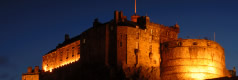
You begin your tour in Edinburgh, capital of Scotland and home to the iconic Edinburgh Castle. Anchored on ancient (extinct!) volcanic rock, this impressive Royal fortress towers 260ft above the city and dominates the landscape for miles around. The site has been occupied since around 900BC, however it was really under King David I, who ruled Scotland from 1124 – 1153, that the castle began to take shape as a fortified military base. Later in the 1460s the Stewart King James III began developing the site as a permanent home as well as a military fortress. Mary, Queen of Scots, gave birth to her son, the future King James VI, in the Castle in 1566. The Castle has been beseiged many times over the centuries, including an unsuccessful attempt by Jacobite forces during the Uprising of 1745. To this day the Castle is an active military base for the British Army. The Honours of Scotland (the Scottish “Crown Jewels”) and the Stone of Scone (or Stone of Destiny, used in the coronation of Scottish monarchs, and later English and British monarchs, for centuries) are kept on permanent display in the Crown Room of the Castle.
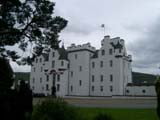
Blair Castle in Perthshire has been home to the Dukes and Earls of Atholl for centuries, indeed there has been a castle on this site since 1269. Of strategic importance due to it’s geographical location, Blair was the gateway to the north and Inverness. It was beseiged twice, by Cromwell in 1652 and the Jacobites shortly before the Battle of Culloden in 1746. The Castle is home to the regiment of the Atholl Highlanders, the only private army in Europe. The castle features many superbly furnished rooms and also has extensive gardens and grounds.
Moving further north, the romantic ruins of Urquhart Castle sit on a rocky promontory jutting out onto Loch Ness. The castle has a turbulent history and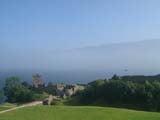 has changed hands many times over the years. It last saw action in 1689, when a small garrison supporting Protestant rule held off a larger Jacobite force. The garrison eventually left the castle, unfortunately blowing up a good deal of it on the way out! There is an excellent new visitor centre here detailing the castle’s history, and remember to keep an eye on the Loch from the castle ramparts – you never know what is lurking in the waters beneath!
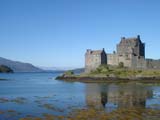 Heading west to Kintail you will find the beautiful Eilean Donan Castle. Surely one of Scotland’s most photographed castles, the castle is the ancestral home of the Clan Macrae. Situated on an island where three sea lochs meet (Loch Alsh, Loch Duich and Loch Long), Eilean Donan has had a tumultuous history. The island upon which the castle is built is believed to be the site of a monastic cell belonging to the Irish bishop, St Donan (Eilean Donan from the Gaelic meaning Island of Donan). The castle fell into disrepair in the 1800s but was restored in the early 1900s by Lietenant Colonel John Macrae Gilstrap.
{phocamaps view=map|id=3}
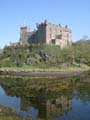 Crossing the bridge to the Isle of Skye at Kyle of Lochalsh, you head north on the island to dramatic Dunvegan Castle, home to the Clan MacLeod for the past eight centuries. A solid fortress rising from a rocky outcrop on the eastern side of Loch Dunvegan, the castle is almost surrounded by the sea at high tide with dramatic sheer rock falls on three sides.
Further south on the Isle of Mull you will find Duart Castle. Situated on a peninsula looking out over the Sound of Mull, the castle is the ancestral home of the Clan Maclean. There has been a fortification on this site since early times and again the site is strategically important, as the castle stands at the confluence of the Sound of Mull, the Firth of Lorne to the south west and Loch Linnhe to the north east. It retains a number of cannons, with beautiful views from the ramparts.
Back on the mainland Dunstaffnage Castle, just outside Oban, is your next port of call. There is thought to have been a castle on this site since the 600s, however much of what you can see today was constructed by the Macdougall Clan in the 1200s. It was garrisoned by government troops during the Jacobite Uprising of 1745, and served as a prison for Flora MacDonald in 1746 after she was arrested for aiding the escape to France of Bonnie Prince Charlie.
South from Dunstaffnage you reach Kilchurn Castle, built in around 1450 by Colin Campbell, First Lord of Glenorchy. The impressive ruins stand on the shore of Loch Awe, and you can see the medieval towers along with the remains of a 3 storey L-shaped barracks, built to house 200 troops in the 1690s.
South again down the Mull of Kintyre to Inveraray Castle, a stronghold of the Clan Campbell since the 1400s. After the building was destroyed by fire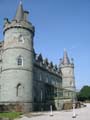 in 1877, the castle was rebuilt in the Scots Baronial style and this is largely what we see today. The castle is simply stunning, with sumptuos interiors, an impressive armoury hall and extensive gardens.
Heading east through the Trossachs you reach the superb Stirling Castle, the last stop on your route. Visible for miles around, the Castle is strategically built on an elevated site near to the lowest fording point of the River Forth. Stirling Castle has a fascinating story to tell and it is central to the history of Scottish independence. Two of the most famous battles in Scottish history were fought in it’s shadow – the Battle of Stirling Bridge where William Wallace defeated the English in 1297 , and the Battle of Bannockburn where the English were again ousted by the forces of Robert the Bruce in 1314. The castle has been home to many Scottish kings, and Mary Queen of Scots was crowned here in 1543. There is lots to see at the castle: some highlights include the Great Hall (the largest medieval banqueting hall ever built in Scotland), the Great Kitchens, and the Regimental Museum of the Argyll & Southern Highlanders.
Related articles: Welcome to Scottish Highland Trails; Accommodation; Scottish Castle Tours