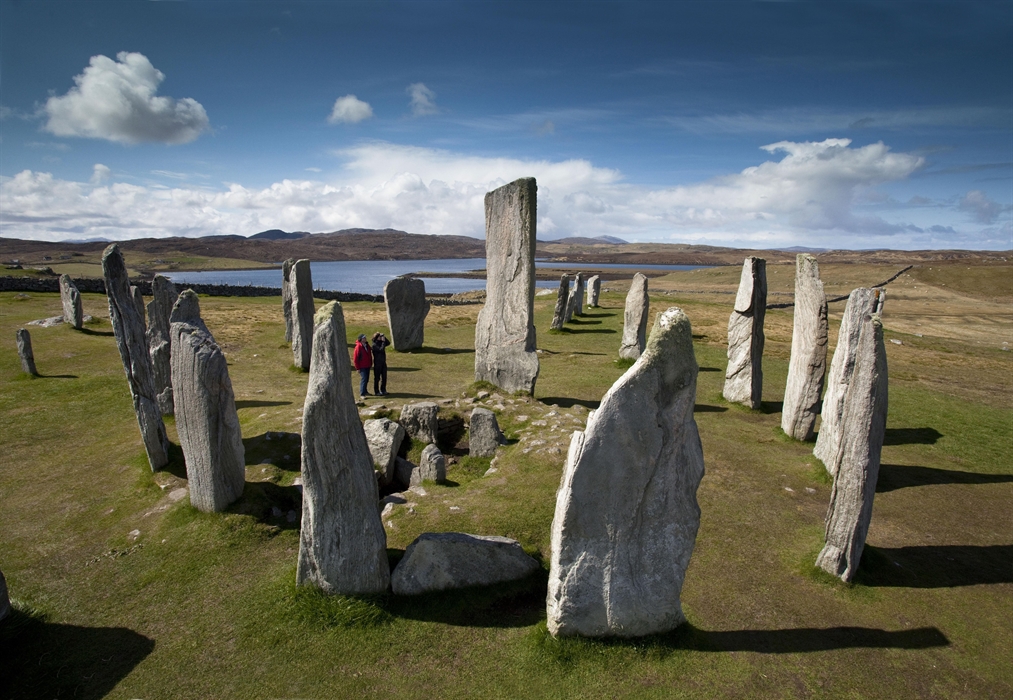
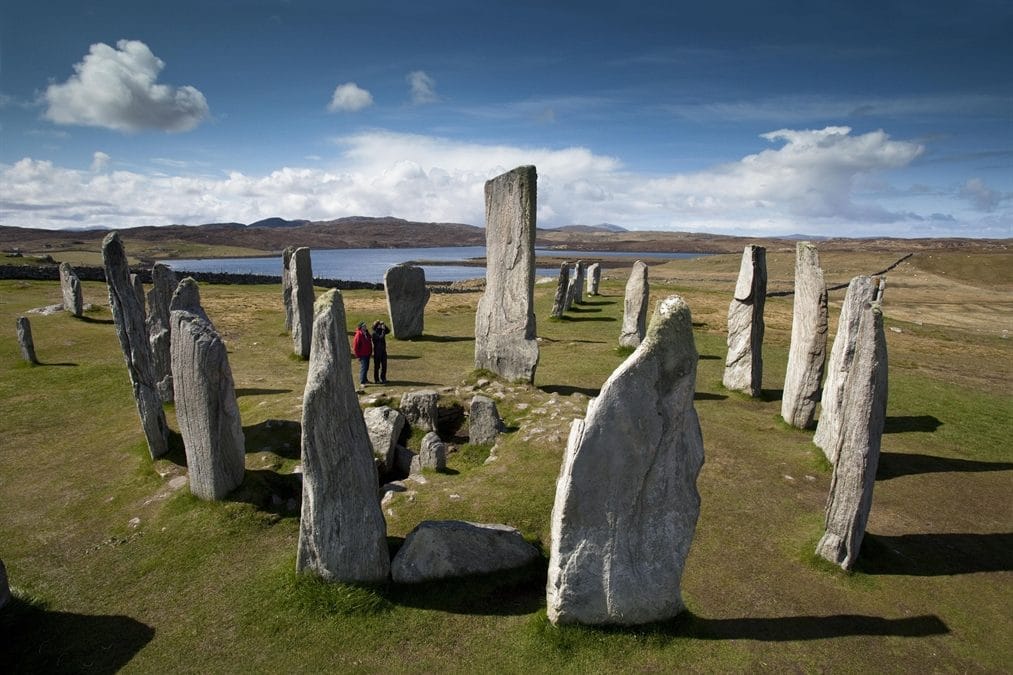
On the western edge of the Isle of Lewis in the Outer Hebrides, overlooking the waters of Loch Roag, stand the mysterious Calanais standing stones. Erected around 5000 years ago, the stones form a circle surrounded by a cruciform shape, and are believed to have been an important site of ritual activity during the Bronze Age. A chambered tomb is also contained within the site but this is believed to have been added at a later date. Numerous other sites lie nearby, many within view of the main site, including several other stone circles and single stones. It is believed that this area was a focus for ritual and religious activity for over 1500 years, before finally being abandoned around 800 BCE.
So why are the stones here and what purpose did they serve? It is generally assumed that the stones at Calanais functioned as an astronomical lunar calendar. The moon’s position in relation to the visible horizon varies over time, peaking every 18.61 years. The Calanais Stones accurately mark this cycle.
At the major lunar standstill (the moon’s most northerly position in the night sky during the 18 year cycle) the moon aligns with the southern hills. The shape of the hills form the silhouette of a woman, known as “Cailleach na Mointeach” or the Old Woman of the Moors. The moon rises at the feet of the Old Woman, and slowly travels along the ridge of the hills, framed by the stones.
The next major lunar standstill will occur in April 2025 but you don’t need to leave it until then to visit the Isle of Lewis! The stones are a wonderful place to visit, whatever the season.
Stone circles and standing stones are a fairly common feature of the landscape here in Scotland. There are many carved Pictish stones, particularly in the north east, and Kilmartin Glen in Argyll boasts the highest concentration of Neolithic and Bronze Age remains in mainland Scotland. If you are as fascinated as we are by our distant ancestors then please just let us know, and we can build your tour around visits to some of Scotland’s most intriguing prehistoric sites.

Related posts
Happy 250th birthday to the USA! 🇺🇸🏴
Did you know Edinburgh Castle is home to one of the earliest depictions of the Star Spangled Banner outside of North America?
Deep inside the vaults of the castle, back in about 1780, Americans captured during the Revolutionary War were incarcerated in the castle prisons. One prisoner scratched out a faint image of a ship flying the Stars and Stripes on his wooden cell door. A quiet act of defiance by a sailor far from home, you can still see this if you visit the vaults today!
#bluebadgeguides #scottishtouristguidesassociation #britishguildoftouristguides #scotland #scotlandlover #scotlandexplore #scotlandshots #scotlandisnow #scotlandtravel #Scottish #castle #scottishcastles #IndependenceDay #USA250
... See MoreSee Less
1 CommentsComment on Facebook
I use all of these, all the time! My granny used to tell me I was “as thrawn as a bag o’ weasels” when I was a wee girl 😂💙🏴The Scots language has words for things no other language bothered to name.
Dreich — that specific grey, damp, miserable weather that isn't quite rain but isn't quite not rain either. The English say "overcast." The Scots say dreich, which sounds exactly like it feels.
Thrawn — stubborn in a particular way. Not just obstinate. Twisted, contrary, determined to do it the wrong way on purpose. There is no English equivalent because English speakers apparently gave up trying to describe this personality type.
Glaikit — vacant. Dopey. The expression on someone's face when the lights are on but nobody is home.
Couthie — warm, friendly, comfortable in a homely way. The feeling of a kitchen that smells like baking and has a dog asleep by the fire.
Wheesht — be quiet. But with feeling. Haud yer wheesht is the full version, and it means be quiet right now and I mean it.
Scunnered — utterly fed up. Beyond tired of something. A level of exasperation English doesn't have a single word for.
Every language reveals the priorities of the people who speak it.
Scottish priorities, apparently, include very specific weather, very specific stubbornness, and very specific silence.
Which one is your favorite? 👇
#ScottishHistory #ScottishHeritage #ScotsLanguage #ScottishWords
... See MoreSee Less
1 CommentsComment on Facebook