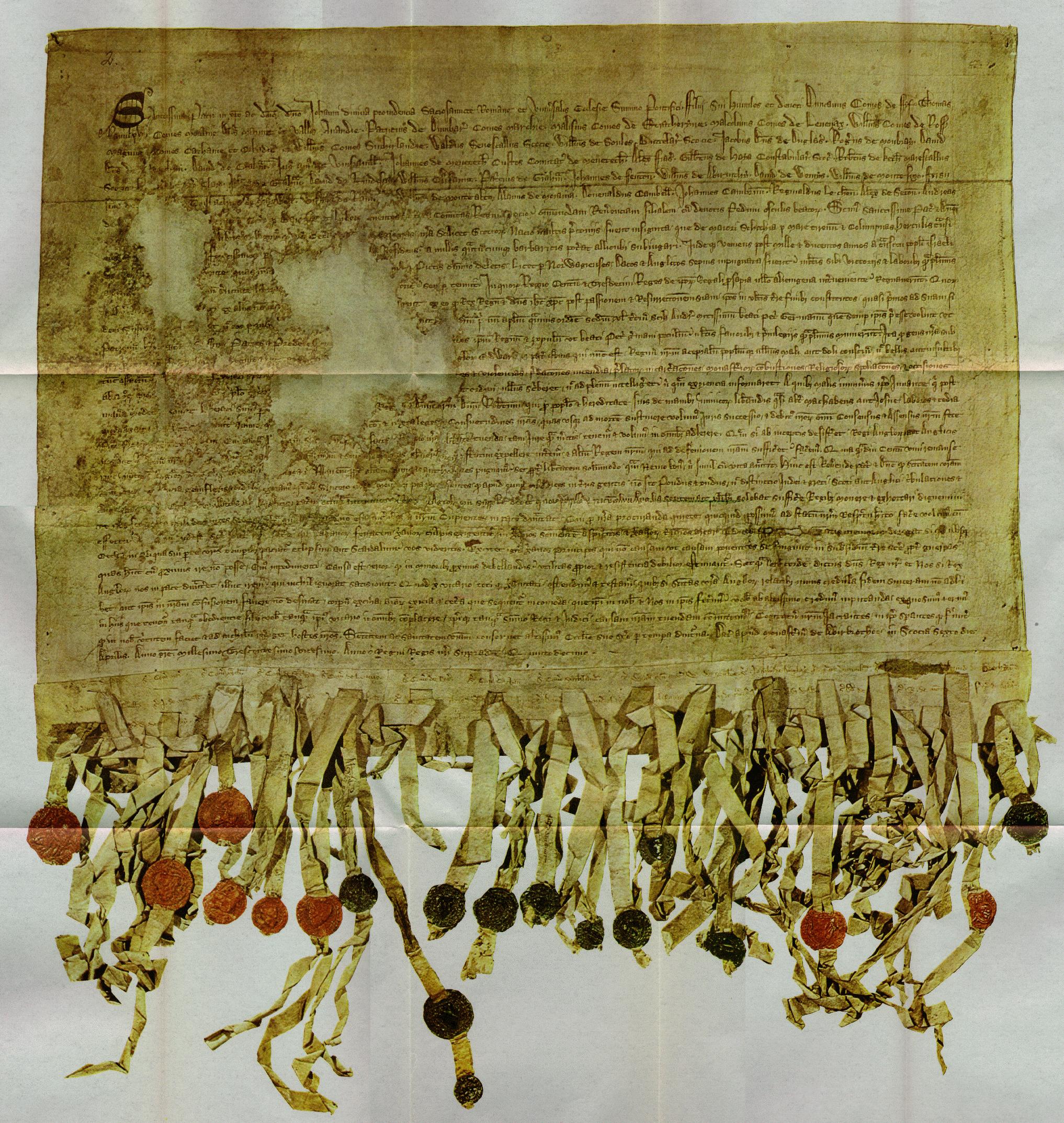

The Declaration of Arbroath is widely considered to be the most important document in Scottish history. It is a letter, drafted in 1320 by Bernard, Abbot of Arbroath, signed by the noblemen of Scotland with their wax seals attached, and addressed to the Pope. It was written at the height of the Wars of Independence and sought to confirm Scotland’s status as an independent nation and to reject any English claim of sovereignty. Importantly, the letter was written on behalf of the people, and not the king. This was a radical concept for the time: the Scottish King, Robert the Bruce, was the first ruler in Europe brought to power by a system recognisable as modern democracy by “due consent and assent of us all” and the Declaration contains the seeds of what we now consider to be modern democracy.
The words of the Declaration are ardent and stirring – Abbot Bernard today would be considered a master of PR! The Scots needed to convince Pope John XXII of the righteousness of their cause and the Declaration is a passionate and eloquent plea for Scottish nationhood and the right to freedom for all. Bernard’s text is also thought to have influenced the wording of the American Declaration of Independence some 450 odd years later – half of those who signed the US Declaration were of Scottish descent.
“As long as but a hundred of us remain alive, never will we on any conditions be brought under English rule. It is in truth not for glory, nor riches, nor honours that we are fighting, but for freedom – for that alone, which no honest man gives up but with life itself”
The Declaration may not have had the immediate result the Scots were hoping for, but it paved the way for the Treaty of Edinburgh–Northampton of 1328. Signed in Edinburgh by Robert the Bruce and ratified in Northampton by the English parliament, the peace treaty brought an end to the first War of Independence and stipulated that the English Crown would recognise Scotland as an independent nation and Bruce and his heirs as the rightful rulers of Scotland.
The 700th anniversary of the signing of this historic document will be celebrated across Scotland in 2020. The town of Arbroath on the east coast will lead the festivities, with many events planned including a horse-led procession of over 500 people marching from Arbroath Abbey to Arbroath Harbour, an atmospheric re-enactment of the Declaration of Arbroath sailing to France in 1320, a giant outdoor lunch on Beacon Green and hundreds of voices singing within the walls of Arbroath Abbey. The famous document will also go on public display for the first time in fifteen years at the National Museum of Scotland in Edinburgh (from 27 March – 26 April). We look forward to welcoming many visitors to Scotland to take part in these fantastic celebrations – don’t miss it!