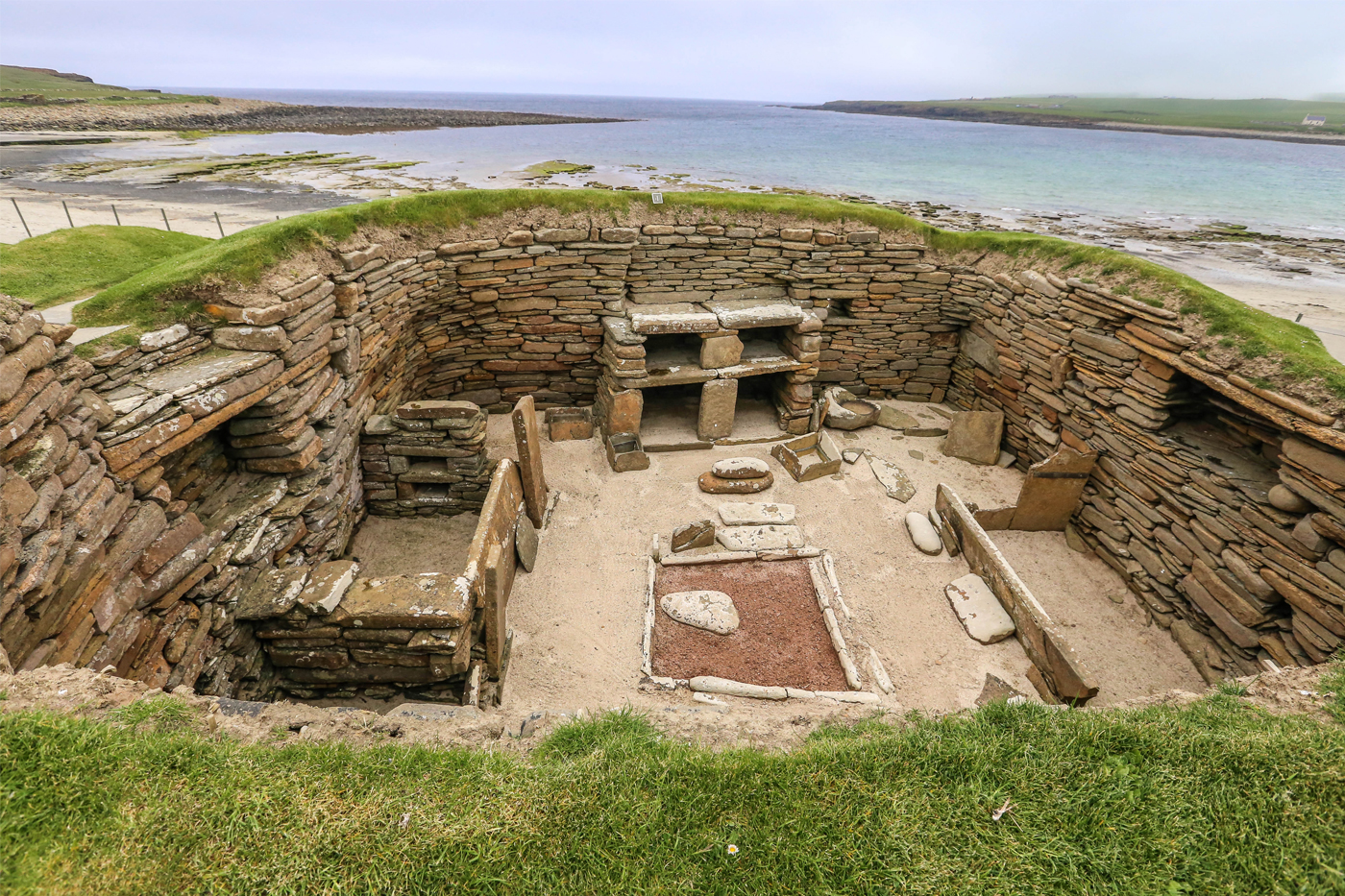
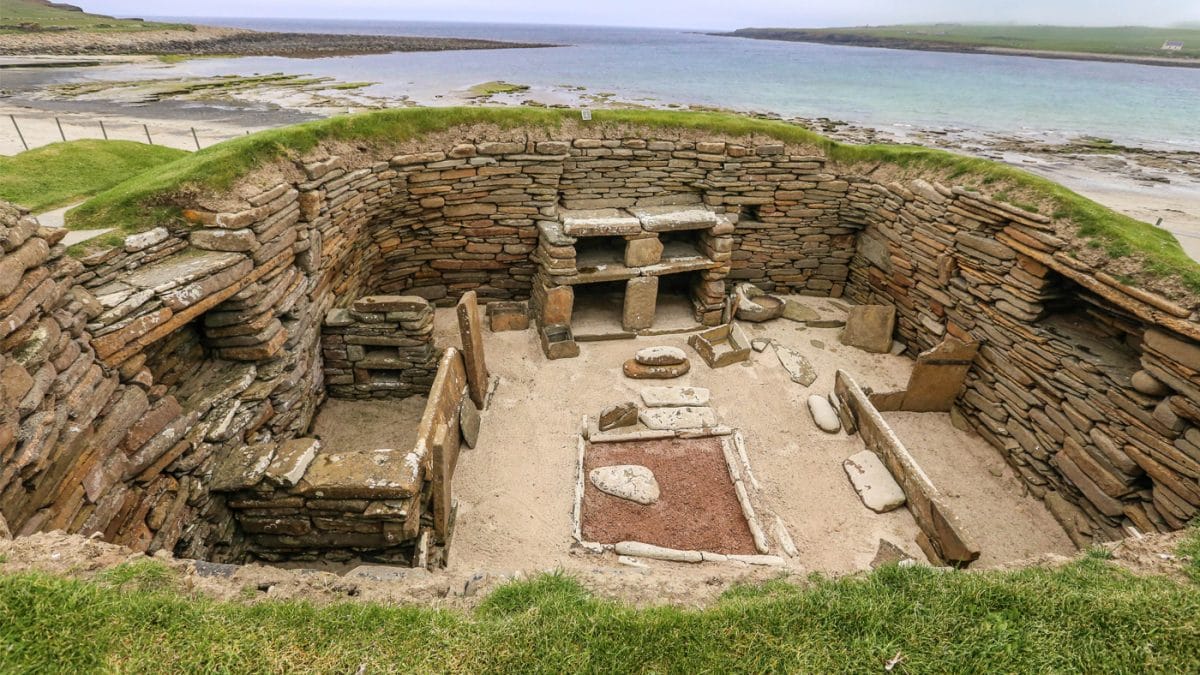
The Orkney Islands lie off the northern coast of Scotland and are easily reached either by air or by ferry. There are over 70 islands making up Orkney, and around 20 of those are inhabited. The islands have been inhabited since early times, and today it is said that Orkney has more ancient sites than anywhere else in Europe. The landscape of these islands is littered with prehistoric monuments, stone circles, and tombs. “The Heart of Neolithic Orkney” is a UNESCO World Heritage Site and includes the Ring of Brodgar standing stones, the Maeshowe chambered tomb which is 5000 years old and the famous prehistoric village of Skara Brae.
Orkney also has a proud Viking heritage. Annexed by Norway in 875, the islands remained an earldom of the Norse kings for several hundred years. Eventually the islands were pledged by the King of Norway as security against the payment of the dowry of his daughter Margaret, who was to marry the Scottish king James III. However, the dowry was never paid, so Orkney was returned to Scottish control in 1472. The Norse influence today can be found in many island place names as well as being celebrated by local artists and crafters.
The islands are mainly low-lying and fertile, and agriculture is the main industry here. There are also cliffs and sea stacks, making Orkney a paradise for birdwatchers, with 21 breeding species. Grey and common seals and puffins are also regular visitors to these shores. Thanks to the Gulf Stream, average temperatures are mild, but the islands are windswept, with few trees as a result.
There is a thriving arts scene, with lots of independent galleries and craft shops, as well as a proud musical tradition, with folk music frequently to be heard in the pubs and bars. And while you’re here you have to sample the local tipples – Highland Park or Scapa whisky, or perhaps some Orkney ales or gin.
It is possible to do a day trip to Orkney from the Scottish mainland however we highly recommend spending a few nights here to make the most of what these islands have to offer.
next

Related posts
Happy 250th birthday to the USA! 🇺🇸🏴
Did you know Edinburgh Castle is home to one of the earliest depictions of the Star Spangled Banner outside of North America?
Deep inside the vaults of the castle, back in about 1780, Americans captured during the Revolutionary War were incarcerated in the castle prisons. One prisoner scratched out a faint image of a ship flying the Stars and Stripes on his wooden cell door. A quiet act of defiance by a sailor far from home, you can still see this if you visit the vaults today!
#bluebadgeguides #scottishtouristguidesassociation #britishguildoftouristguides #scotland #scotlandlover #scotlandexplore #scotlandshots #scotlandisnow #scotlandtravel #scottish #castle #scottishcastles #IndependenceDay #USA250
... See MoreSee Less
1 CommentsComment on Facebook
I use all of these, all the time! My granny used to tell me I was “as thrawn as a bag o’ weasels” when I was a wee girl 😂💙🏴The Scots language has words for things no other language bothered to name.
Dreich — that specific grey, damp, miserable weather that isn't quite rain but isn't quite not rain either. The English say "overcast." The Scots say dreich, which sounds exactly like it feels.
Thrawn — stubborn in a particular way. Not just obstinate. Twisted, contrary, determined to do it the wrong way on purpose. There is no English equivalent because English speakers apparently gave up trying to describe this personality type.
Glaikit — vacant. Dopey. The expression on someone's face when the lights are on but nobody is home.
Couthie — warm, friendly, comfortable in a homely way. The feeling of a kitchen that smells like baking and has a dog asleep by the fire.
Wheesht — be quiet. But with feeling. Haud yer wheesht is the full version, and it means be quiet right now and I mean it.
Scunnered — utterly fed up. Beyond tired of something. A level of exasperation English doesn't have a single word for.
Every language reveals the priorities of the people who speak it.
Scottish priorities, apparently, include very specific weather, very specific stubbornness, and very specific silence.
Which one is your favorite? 👇
#ScottishHistory #ScottishHeritage #ScotsLanguage #ScottishWords
... See MoreSee Less
1 CommentsComment on Facebook