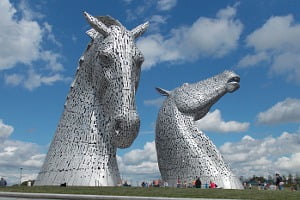

It has been reported in the press today that installation of two 30m high sculptures of the kelpie, or mythical water horse, has begun in Falkirk. Designed by Glasgow based sculptor Andy Scott, these giant beasts will take pride of place in a regeneration scheme aimed at transforming an area of land situated between Falkirk and Grangemouth in the east of Scotland.
It is an interesting choice of symbol for a regeneration project. Traditionally, kelpies are shape shifters, water spirits capable of taking on numerous forms, but most often that of a horse. So maybe this capacity for change is the reason behind the decision to commission the kelpies. However, kelpies are anything but cute wee ponies! Instead they are strong, powerful, malevolent creatures with an appetite for human flesh…
Kelpies appear in various Scottish myths and legends, and are variously described as black (occasionally white) with smooth skin like a seal, but deathly cold to the touch. Frequently they are said to be dripping wet, or they have sea weed in their manes. The name kelpie is thought to derive from the Gaelic cailpeach or colpach which means colt or heifer.
The story goes that the kelpie, disguised as a lost horse, would wait by a riverbank for a unsuspecting, weary traveller. As soon as the traveller tried to mount the horse, it would rear up and then dive deep into the waters, drowning its victim and then eating him. Kelpies are said to have a particular taste for children. According to legend, as the kelpie dragged its victim underwater and became fully submerged, a noise of thunder would echo across the glens.
So the next time you are taking a pleasant summer’s afternoon stroll along the banks of a Scottish river, watch out for an innocent looking black horse casually hanging around close to the water’s edge…if it has sea weed in its mane, don’t bother stopping to give it a sugar lump 😉
Update:
The Kelpies are in place and now open to the public as of April 2014. They look incredible and are visible for miles around! You also get great views from the main M90 road which passes the site. A triumph for public art in Scotland!