

Derry/Londonderry in Northern Ireland has been designated City of Culture 2013, so we thought it was time we took another look at this great city!
The area around Derry/Londonderry has been populated since ancient times, and a monastery was founded here by St Columba in the 6th century. For several hundred years afterwards, Derry was principally known as a monastic settlement. The name Derry comes from the old Irish word “daire” meaning an oak grove. The original oak grove was located on a hill which was formerly an island in the River Foyle; the channel which had run on the westerly side of the island eventually dried up leaving a marshy area which became known as the Bogside.
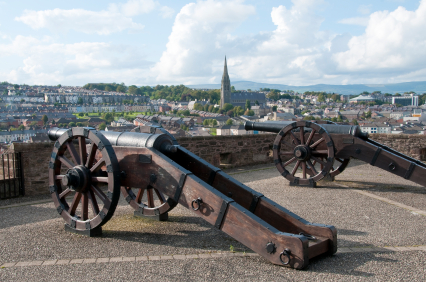
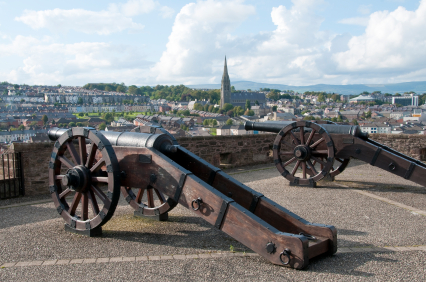
The “Plantation of Ulster” in the 17th century was an attempt to colonise the Irish province of Ulster by the Protestant governments of both Scotland and England. Land owned by the Irish chieftains was confiscated and the city of Londonderry (the first planned city in Ireland) was built across the Foyle from the original settlement. Great walls were built around the city to protect it from attack and the 17th century saw a period of violent unrest.
The Siege of Derry. In 1688 King James II, King of England, Scotland & Ireland and a converted Catholic, was ousted from power by his Protestant daughter Mary and her husband William of Orange. James had considerable support from catholic Ireland and most of the garrisons in Ireland remained loyal to James, with the exception of Derry and Enniskillen. In November 1688, an army of Scottish Catholics marched on Derry, and on 7 December with the army fast approaching, 13 apprentice boys seized the city keys and locked the gates.
In March 1689, James (with the help of his Catholic allies, the French) landed an army in Kinsale in south west Ireland, and marched north, taking Dublin. Continuing north the Jacobite forces reached Derry on 18 April. James asked the city to surrender four times to no avail, and the subsequent Siege of Derry lasted 105 days, with thousands of lives lost on both sides. The siege was eventually broken by a fleet of Royal Navy warships which were finally able to penetrate the floating barrier defences of the River Foyle.
Later in the 18th century Derry was an important point of departure for emigrants seeking a new life in the New World, and some of these founded the colonies of Derry and Londonderry in the state of New Hampshire in the USA. In the 19th century thousands also departed from Derry, fleeing the horrors of the Great Famine.
In the latter half of the twentieth century Derry became a focal point for the civil rights movement in Ireland, culminating in the Bloody Sunday massacre of 1972, however the violence of the Troubles had begun to ease by the late 1980s/early 1990s.
Recent years have seen significant investment in the city and a drive to promote Derry/Londonderry as a tourist destination. Highlights of your visit might include a guided walking tour of the magnificent city walls (one of the finest examples of a walled city anywhere in Europe) or a look at the Museum of Free Derry which is a fascinating look at the history of the Troubles and a must see for anyone with an interest in Irish history. You are less than an hours drive from the Giant’s Causeway, the Bushmills whiskey distillery and the beautiful north Antrim Coast. And 2013 is surely the ideal time to visit Derry/Londonderry, as the year long City of Culture events promise something for everyone, from art exhibitions to music, dance and theatre. In addition, the superb national Fleadh Cheoil (Festival of Music in Ireland) takes place in Derry/Londonderry in August 2013. This celebration of traditional Irish music will showcase the very best musical talent in Ireland with concerts, ceilidhs, parades and street sessions.
For more info on tailor made packages to Derry/Londonderry and the island of Ireland please get in touch – we’d be happy to help!