

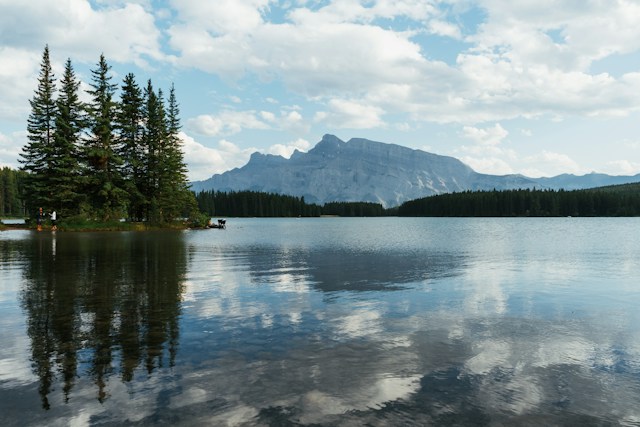
Canada or Scotland? Hard to tell! This is actually near Banff, Alberta, Canada but the landscape is remarkably similar to the Scottish Highlands!
The Scarborough Settler’s Lament
A traditional folksong, the Scarborough Settler’s Lament was written around 1840 by Sandy Glendenning who had emigrated from Scotland to Scarborough, Ontario. It speaks of his homesickness and the contrast between the glens of ‘auld Scotland’ and the rugged landscape of pioneer Canada:
Away wi’ Canada’s muddy creeks
And Canada’s fields of pine
Your land of wheat is a goodly land,
But oh, it is not mine
The heathy hill, the grassy date.
The daisy spangled lea, the purling burn and craggy linn, auld
Scotland’s glens give me.
Oh, I would like to hear again the lark on Tinny’s hill
And see the wee bit gowany that blooms beside the rill.
Like banished Swill who view afar his Alps with longing e’e.
I gaze upon the morning star that shines on my country.
No more I’ll win by Eskdale glen or Pentland’s craggy comb.
The days can ne’er come back again of thirty years that’s gone,
But fancy oft at midnight hour will steal across the sea.
And yestereve, in a pleasant dream, I saw the old country.
Each well-known scene that met my view brought childhood’s joys
to mind.
The blackbird sang on Tushey linn the song he sang, ‘lang syne.’
But like a dream time flies away, again, the morning came.
And I awoke in Canada, three thousand miles frae hame.
Early Settlements & Landmark Voyages
- First Attempt in 1621: Sir William Alexander was granted a royal charter by King James VI to establish “New Scotland” (Nova Scotia) in the 1620s, though early settlements struggled and were short-lived.
- The Ship Hector (1773): Often called the “Canadian Mayflower,” the Hector arrived in Pictou, Nova Scotia, on September 15, 1773, carrying 189 Highlanders and sparking sustained Scottish migration to the Maritimes.
- Lord Selkirk’s Settlements: In the early 1800s, Thomas Douglas, 5th Earl of Selkirk, funded major settlements for displaced Highlanders in Prince Edward Island (1803) and later the Red River Colony in present-day Manitoba.
- The 1803 Passenger Vessels Act: Concerned about losing skilled workers and military recruits, British lawmakers passed legislation restricting how many passengers ships could carry and mandating food and water rations—driving up ticket prices in an attempt to slow emigration.
Economic & Environmental Triggers
- Collapse of the Kelp Industry: After the Napoleonic Wars ended in 1815, the booming Highland kelp-ash industry collapsed, wiping out the primary cash income for thousands of Hebridean families.
- The Highland Potato Famine (1846–1856): Similar to Ireland, potato blight devastated Highland crops, prompting charities and landlords—such as the Highland and Island Emigration Society—to fund mass passages to Canada.
- Hudson’s Bay Company Recruits: Throughout the 18th and 19th centuries, the Hudson’s Bay Company heavily recruited young men from the Orkney Islands to work as fur traders and labourers across northern Canada, with many staying permanently.
Shaping Modern Canada
- Political Leadership: Canada’s first two Prime Ministers – Sir John A Macdonald (born in Glasgow) and Alexander Mackenzie (born near Dunkeld) – were Scottish immigrants, and over half of Canada’s prime ministers claim Scottish roots.
- Healthcare & Infrastructure: Falkirk-born Tommy Douglas championed Canada’s universal public healthcare system, while Kirkcaldy-born engineer Sir Sandford Fleming designed much of the Canadian railway network and is credited as the inventor of standard worldwide time
- Language & Place Names: Canadian Gaelic was once the third most commonly spoken language in Canada after English and French. Scottish settlers also named dozens of towns and cities after home, including Calgary (named after Calgary Bay on the Isle of Mull), Banff, Airdrie, Inverness and Glengarry.
The links between the two countries go even deeper, down to the bedrock of the land itself. Long before humans ever walked the Earth, Scotland and Canada were literally attached. Around 400 million years ago, during the time of the supercontinent Pangea, the Scottish Highlands and the mountains of Atlantic Canada and Newfoundland were part of the exact same mountain range.
The supercontinent eventually split and drifted apart. But whether you are standing on a rugged peak in the Scottish Highlands or peering up at the rocky cliffs of Newfoundland, you are looking at the same ancient rock formation. Talk about a deep-rooted connection!
Perhaps your ancestors left Scotland many years ago and ended up in Canada? Contact us for more information if you are thinking of making that journey in reverse to roam “auld Scotland’s glens”.
From the Highlands to the Prairies: Why So Many Scots Emigrated to Canada