
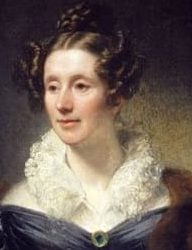

To celebrate Women’s History Month, this March we take a look at some of Scotland’s most influential historical women. We’re kicking things off with Mary Fairfax Somerville, often referred to as the world’s first scientist.
Mary Fairfax Somerville (1780 – 1872)
Born at her uncle’s home at the manse (the minister’s house) in the grounds of Jedburgh Abbey in the Scottish Borders, the rest of Mary’s childhood was spent in the coastal town of Burntisland in Fife. She received what would be considered a traditional education for a young lady at that time, spending just one year at a boarding school for girls in Musselburgh studying basic reading, writing and arithmetic. The rest of her education was devoted to ladylike pursuits such as needlework, playing the piano and drawing.
However Mary had greater ambition – with the help of her uncle in Jedburgh she taught herself Latin, followed by French and Greek, and borrowed books on algebra and geometry from her brother’s tutor, developing a lifelong passion for the study of mathematics. Her obsession with maths was a matter of grave concern for her parents, leading her father to worry that “the strain of abstract thought would injure the tender female frame”.
Following marriage to her cousin William Somerville, (the son of the uncle at Jedburgh), the couple moved to London. Here she met with leading scientists and mathematicians from across Europe, who, along with her new husband, encouraged her intellectual interests. Her areas of research were multi-disciplinary, encompassing mathematics, physics, chemistry and astronomy. She was to publish five books including On the Connexion of the Physical Sciences which is considered one of the first popular science books. It sold over 15,000 copies and established her reputation as one of the leading scientists of the day. In fact, the term “scientist” was first used to describe Mary (previously the term commonly used would have been “man of science”). In 1835 she was one of the first women to be elected to the Royal Astronomical Society.
A fervent supporter of women’s suffrage, women’s rights and women’s education, Mary was invited to be the first signatory on a suffrage petition presented to parliament in 1868.
Somerville College, Oxford University was named after her, and Mary’s image features on the Royal Bank of Scotland £10 note.
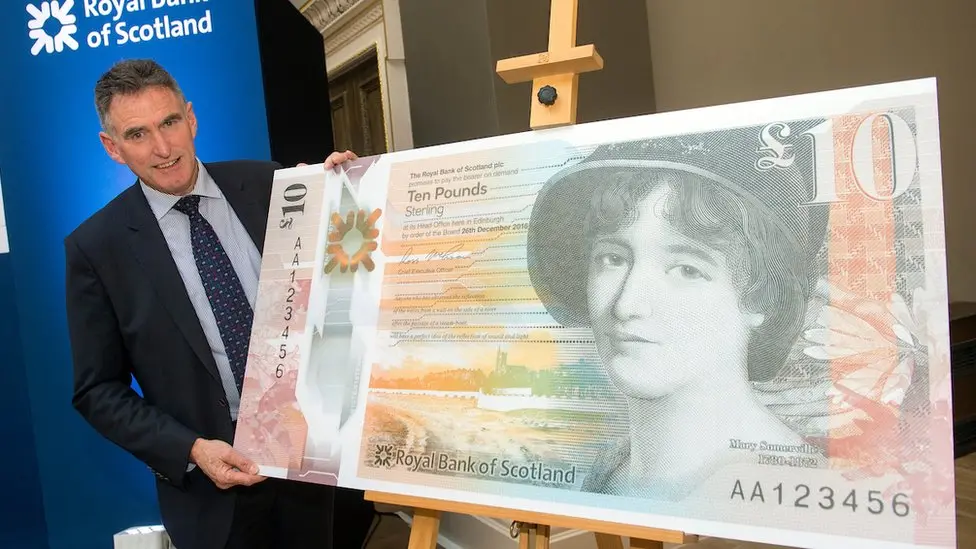
Photo credit RBS
Mary Somerville, the First Scientist